
C4 Complement Test (Serum) – Role in Autoimmune and Complement Disorders
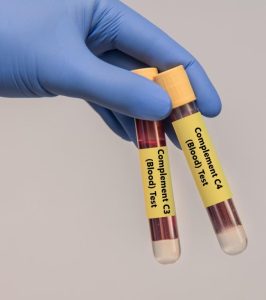
C4 Complement Test (Serum).
Synonyms: C4, Complement C4
Specimen Details
- Type: Serum
- Container: Red top tube
Storage Instructions
Allow specimen to clot at room temperature for 15–30 minutes, then at 4°C for 30–60 minutes. If testing is delayed, store serum at 4°C.
Reference Range
200–800 μg/mL
Use
The C4 Complement test is used to:
- Diagnose inherited deficiencies of the C4 protein
- Monitor conditions with increased complement consumption, such as:
- Systemic lupus erythematosus (SLE)
- Serum sickness
- Glomerulonephritis
- Chronic active hepatitis
- Hereditary angioedema
Methodology
- Radial Immunodiffusion (RID)
- Rate Nephelometry
Limitations
C4 has a short half-life and behaves as an acute phase reactant. A single test may not be conclusive—serial testing offers better diagnostic value.
Additional Information
C4 is only involved in the classical complement pathway. Thus, its decrease signals activation of this pathway, unlike the alternative pathway which leaves C4 levels unaffected.
In autoimmune diseases like lupus, immune complex formation often reduces C4, C3, and CH50 levels. C4 is particularly predictive of lupus activity. In hereditary angioedema, C4 levels drop due to C1 esterase inhibitor deficiency, which causes unregulated C4 degradation.
Inherited C4 deficiency (often autosomal recessive) has strong HLA linkage and may present with SLE-like features, Henoch-Schönlein purpura, or glomerulonephritis. It also predisposes individuals to recurrent bacterial infections, especially from encapsulated organisms.
References
- Bishof NA, Welch TR, Beischel LS. “C4B Deficiency: A Risk Factor for Bacteremia With Encapsulated Organisms.” J Infect Dis. 1990;162(1):248–50.
- Colvin RB, Bhan AK, McCluskey RT, eds. Diagnostic Immunopathology. Raven Press, 1988.
- Frank MM. “Complement in the Pathophysiology of Human Disease.” N Engl J Med. 1987;316:1525–30.
- Jackson CG, Ochs HD, Wedgwood RU. “Immune Response With C4 Deficiency and SLE.” N Engl J Med. 1979;300:1124–9.
- Nusinow SR, Zuraw BL, Curd JG. “Hereditary and Acquired Deficiencies of Complement.” Med Clin North Am. 1985;69:487–504.
- Ruddy S. “Complement.” In: Manual of Clinical Laboratory Immunology, 4th ed. ASM Press, 1992.
- Jacobs et al. Laboratory Test Handbook. Lexi-Comp Inc, 1994.


