Filariasis Serological Test: Diagnosis of Microfilariae & Antibody Detection
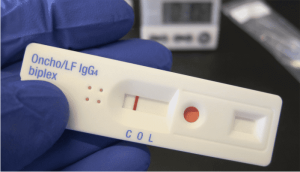
Filariasis Serological Test
Synonyms
Serological test for filariasis
Applies To
- Acanthocheilonema perstans Serology
- Loa Loa Serology
- Onchocerca volvulus Serology
- Wuchereria bancrofti Serology
Abstract
Filarial nematodes inhabit lymphatics, subcutaneous tissues, or cavities in adult stages. Microfilariae are transmitted via blood-feeding arthropods and develop into infectious forms. Serological testing supports diagnosis of filarial infection.
Specimen
Type: Serum
Container: Red top tube
Reference Range
Ranges depend on methodology and laboratory standards.
Use
Supports the diagnosis of microfilariasis and systemic filarial infections.
Limitations
- Lack of species-specific purified antigens reduces sensitivity and specificity.
- IgG4 subclass antibodies help reduce cross-reactions.
- Antibodies to phosphocholine can cause false positives.
Methodology
- Bentonite Flocculation Assay (BFA)
- Indirect Fluorescent Antibody (IFA)
- Indirect Hemagglutination (IHA)
- Enzyme Immunoassay (EIA)
Additional Information
Antigen from Dirofilaria immitis is used for general screening, but has low specificity. Using species-specific antigens increases diagnostic accuracy. Blood film morphology remains a key diagnostic tool. IgG4 testing improves specificity, especially in Onchocerciasis and Loa loa infections.
References
- Ash LR & Orihel TC. Atlas of Human Parasitology, 3rd ed., ASCP Press, 1990.
- Kagan IG & Maddison SE. Manual of Clinical Laboratory Immunology, 4th ed., 1992.
- Lal RB & Ottesen EA. J Infect Dis, 1988, 158:1034-37.
- Weil GJ et al. J Infect Dis, 1990, 161(3):549-54.
- Jacobs et al., Laboratory Test Handbook, Lexi-Comp Inc, 1994.